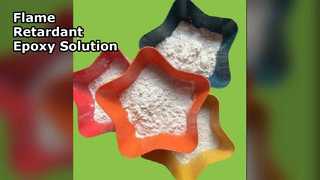
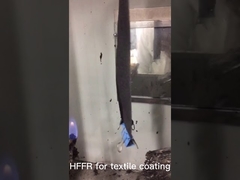
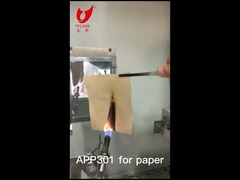
Brief: Wondering how this halogen-free flame retardant compares to other options? In this video, we demonstrate how Nitrogen Containing Melamine Cyanurate (MCA) provides high-efficiency flame retardancy for PA6 and PA66 polymers. You'll see its mechanism of action through heat absorption and gas release, explore its key specifications, and learn about its applications in various resins and coatings.
Related Product Features:
A halogen-free, environmentally friendly flame retardant containing nitrogen for enhanced safety.
Operates through sublimation heat absorption and decomposition into inert gases like nitrogen and water vapor.
Exhibits high thermal stability with a decomposition temperature starting above 300°C, suitable for most resin processing.
Features very low solubility in water and a neutral pH, ensuring compatibility and stability in formulations.
Offers high whiteness and fine particle size for uniform dispersion and minimal impact on product aesthetics.
Requires small addition amounts due to high flame retardant efficiency, optimizing cost and performance.
Suitable primarily for PA6 and PA66, and can be combined with other retardants for PBT, PET, EP, TPE, and TPU.
Can also function as a solid lubricant when added to oils and greases, adding versatility to its applications.
FAQs:
What is the primary mechanism of flame retardancy for Melamine Cyanurate (MCA)?
MCA acts as a flame retardant by absorbing heat through sublimation and decomposing at high temperatures into non-flammable gases like nitrogen, water vapor, and carbon dioxide. These gases dilute oxygen and cool the material, effectively suppressing combustion.
Which polymers is MCA most suitable for?
MCA is especially effective for polyamide 6 (PA6) and polyamide 66 (PA66). It can also be used in combination with other flame retardants for applications in PBT, PET, epoxy resins (EP), TPE, TPU, and textile coatings.
What are the key advantages of using a halogen-free flame retardant like MCA?
MCA offers several benefits: it is halogen-free and environmentally friendly, has high thermal stability for processing, requires low addition amounts for efficiency, and maintains high whiteness and low solubility, making it safe and versatile for various industrial applications.